

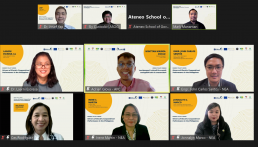
Through the Access to Sustainable Energy Programme-Clean Energy Living Laboratories (ASEP-CELLs), the Ateneo School of Government, with the funding support from the European Union, held the eight and final installment of the virtual Energy Policy Series (EPS) last December 10, 2021.
With more than 50 participants from various government agencies, academic institutions, private sector, and civil society, ASEP-CELLs’ senior research fellow Dr. Laarni Escresa and research assistant Adrian Matthew Glova presented their working paper titled, “Drivers of Electric Cooperatives’ Performance in the Philippines: A Principal Component Analysis and K-Means Clustering Approach.”
Joining the panel were Engr. John Carlos Santos, Ms. Irene Martin, and Ms. Jonnalyn Marco from the National Electrification Administration (NEA), and Ms. Ma Cecilia Rodriguez from the Ateneo de Davao University, as reactors and moderator, respectively.
Mr. Glova introduced the topic by elaborating on the history and role of electric cooperatives (EC) for national development in the Philippine context. He went on to explain how ECs have been assessed in the past, and how their research can offer a new insight into evaluating EC performance.
“We offer, in effect, a validation tool to enhance the credibility of their (NEA’s) performance assessments.”, Mr. Glova said. “This paper fills a gap in the literature in assessing ECs as we create performance indices empirically and classify these ECS based on these principal components.”
The results yielded two primary drivers of EC performance, size or scale index and efficiency index. ECs with similar performances were grouped and have found to be well separated, which, as Mr. Glova said, can be used to validate existing assessment tools.
NEA’s Engr. Santos agrees with the principal components that were derived from the study and believes that these parameters will validate EC performance. Engr. Santos also points out governance and leadership issues that contribute to the underperformance of less efficient ECs.
Dr. Escresa supplemented the discussion with the potential of rank-ordering in assessing EC performance since this provides more information for relevant actors outside the energy sector.
“Financial institutions may be interested in these performance indicators to assess their creditworthiness. As you know, investment is very needed in rural electrification, and that would be very useful for ECs.”, Dr. Escresa explained.
The open forum was moderated by Ms. Rodrigue where points on various methodologies and indicators that can be used to assess EC performance were highlighted. Dr. Escresa explained that specific purposes for evaluating ECs would require different (but valid, all the same) methodologies.
Other topics revolved around ways on how to improve the process of assessing EC performance with the involved stakeholders.
Access the working paper of Dr. Escresa, and Mr. Glova here. A recording of the webinar is also available through the ASOG Facebook page.